2025 Guide: How to Choose the Best DC to DC Converter for Your Needs
In the rapidly evolving landscape of power electronics, the significance of selecting the right DC to DC converter cannot be overstated. According to a recent market analysis by industry research firm MarketsandMarkets, the DC to DC converter market is projected to reach $14.6 billion by 2025, growing at a CAGR of 4.8%. This growth is driven by the increasing demand for efficient power management solutions in various applications, including renewable energy systems, electric vehicles, and consumer electronics.
Expert voices in the field highlight the criticality of making informed choices. Dr. Jane Holloway, a leading authority on power electronics and author of the comprehensive guide “Power Management in Modern Electronics,” emphasizes, "The right DC to DC converter not only enhances system efficiency but also extends the lifespan of connected devices." Her insights underline the importance of understanding both the technical specifications and the application requirements when selecting a DC to DC converter. As industries continue to innovate, the decision-making process in this domain will increasingly influence energy efficiency and operational effectiveness in numerous sectors.
Navigating the diverse options available in the DC to DC converter market requires careful consideration of factors such as input voltage range, output power requirements, and thermal performance. With a burgeoning array of choices, this guide aims to simplify the selection process by outlining key considerations that align with current technological advancements and industry standards.

Understanding DC to DC Converters: An Overview of Technology and Applications
DC to DC converters are critical components in modern electronics, providing voltage regulation and power efficiency across various applications. These devices are designed to convert a direct current (DC) voltage input into another DC voltage output, making them essential for applications ranging from consumer electronics to automotive and industrial equipment. According to a report by Fortune Business Insights, the global DC to DC converter market is projected to grow from $3.22 billion in 2020 to $5.12 billion by 2028, at a CAGR of 6.0%. This growth indicates the increasing reliance on these converters as electronic devices become more sophisticated and require precise power management.
The technology behind DC to DC converters has evolved significantly, with advancements such as synchronous rectification and digital control offering improved efficiency and performance. A study published by TechSci Research highlights that isolated converters are expected to witness growth due to their ability to provide higher efficiency and safety in electric vehicle applications. As industries adopt more energy-efficient systems, understanding the distinct advantages of various DC to DC converter types—such as buck, boost, and buck-boost converters—is vital for selecting the right solution for specific needs, whether for renewable energy systems or portable electronics.
2025 Guide: How to Choose the Best DC to DC Converter for Your Needs
| Feature |
Details |
| Input Voltage Range |
3V - 30V |
| Output Voltage |
1.2V to 24V |
| Output Current |
1A to 10A |
| Efficiency |
Up to 95% |
| Regulation Type |
Linear and Switching |
| Operating Temperature |
-40°C to 85°C |
| Applications |
Consumer Electronics, Automotive, Industrial |
| Size (L x W x H) |
40mm x 20mm x 15mm |
Key Factors to Consider When Choosing a DC to DC Converter
When choosing the best DC to DC converter for your needs in 2025, several key factors must be considered. The global market for automotive power modules is projected to grow significantly, from $9.86 billion in 2025 to $25.14 billion by 2032, with a compound annual growth rate (CAGR) of 14.3%. This surge reflects the increasing demand for efficient power solutions driven by the rapid advancements in big data and the Internet of Things. As communication base stations and data centers proliferate, it is crucial to select a DC-DC converter that can provide stable power output while enhancing overall system performance.
Two critical factors to evaluate when selecting a DC to DC converter are efficiency and performance. With the evolving needs of modern electronics, from telecommunications to data processing, having a high-efficiency converter minimizes power losses, thereby maximizing performance. Additionally, understanding the specific voltage and current requirements of your application can ensure that the converter operates within its optimal range, further enhancing reliability. As the domestic power chip industry evolves into a new era of communication technology, investing in the right DC-DC converter becomes paramount for achieving robust and efficient power management in your projects.
Types of DC to DC Converters and Their Specific Uses
When selecting a DC to DC converter, understanding the various types is crucial for meeting specific application needs. The two most common types are buck converters and boost converters. Buck converters efficiently step down voltage levels, making them ideal for applications such as powering microcontrollers from a higher voltage source. According to a recent report by MarketsandMarkets, the global buck converter market is expected to reach USD 9.15 billion by 2025, reflecting a growing demand for energy-efficient solutions in portable and battery-operated devices.
On the other hand, boost converters are designed to step up voltage from a lower source, which is essential for applications needing higher voltages, such as LED drivers and battery management systems. A study by Grand View Research indicates that the demand for boost converters is projected to grow significantly, driven by advancements in electric vehicles and renewable energy systems. Each converter type serves unique roles in electronics, highlighting their importance in creating optimized power management solutions for diverse applications across various industries.
2025 Guide: Types of DC to DC Converters and Their Uses
Evaluating Input and Output Specifications for Your Converter Needs
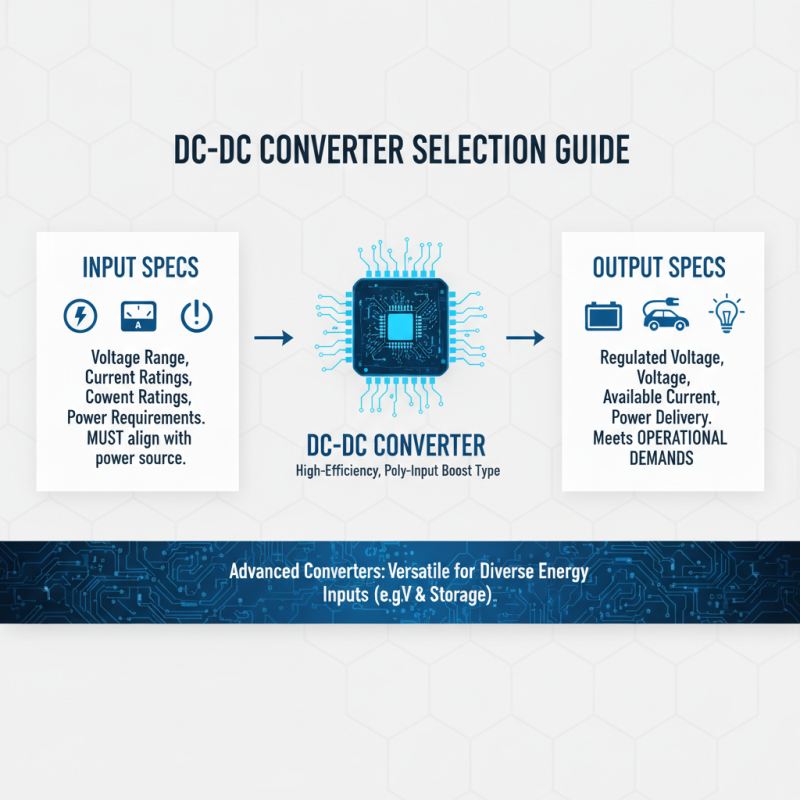
When choosing a DC to DC converter, evaluating the input and output specifications is critical to ensure that the converter meets your operational demands. Input specifications include voltage range, current ratings, and power requirements, which must align with the source from which power will be drawn. Recent research highlights a high-efficiency poly-input boost DC–DC converter tailored for energy storage and electric vehicle applications, showcasing that advanced converters can operate optimally across various power sources. This versatility is crucial for applications requiring adaptability to different energy inputs.
Output specifications, such as voltage regulation, ripple voltage, and load capability, play a pivotal role in the performance of a DC to DC converter. For instance, a study on multi-load and multi-source DC-DC converters emphasizes the necessity for efficient power delivery in electric vehicles. This system's ability to manage multiple output loads while maintaining performance under varying conditions demonstrates the importance of selecting converters that can maintain efficiency and stability. Understanding these specifications through comprehensive performance evaluations can equip you with the knowledge to make informed decisions tailored to your specific application.
Safety, Efficiency, and Regulatory Considerations for DC to DC Converters
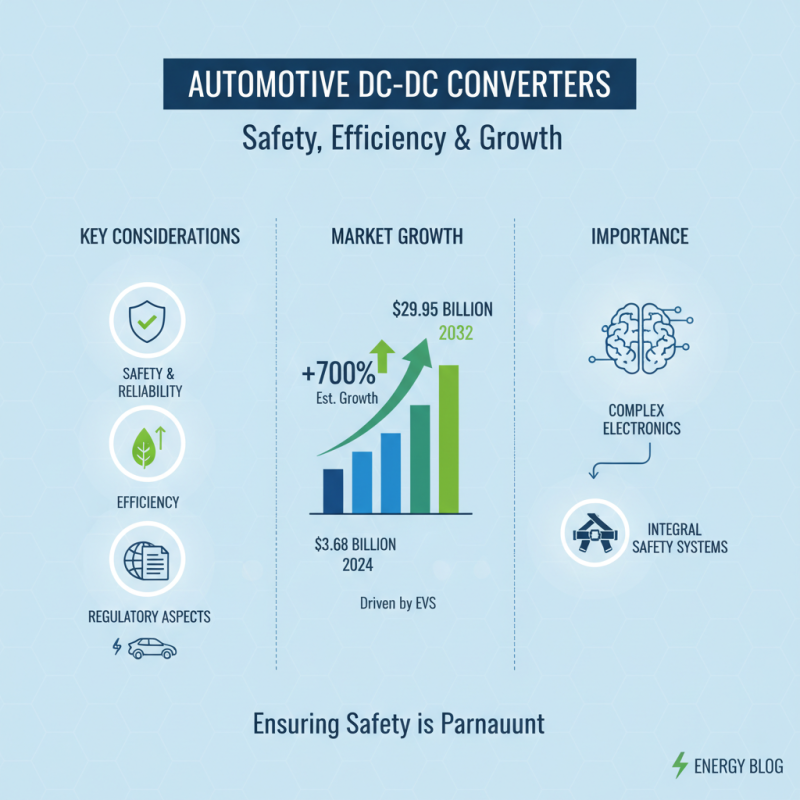
When choosing a DC to DC converter, it is essential to consider safety, efficiency, and regulatory aspects. The global automotive DC-DC converter market is expected to grow significantly, increasing from $3.68 billion in 2024 to an impressive $29.95 billion by 2032, driven by the rising demand for energy-efficient electric vehicles. With such rapid market growth, ensuring the safety and reliability of these converters is paramount, particularly in complex vehicle electronics where safety systems are integral.
To enhance efficiency, look for converters equipped with advanced features like integrated ferrite-bead compensation, which reduces noise and improves performance. The implementation of high step-up converters can optimize energy conversion from fuel cells, further showcasing the innovation within this field.
**Tips:**
1. Always assess the thermal performance and EMI characteristics of your DC-DC converter to ensure compliance with industry standards.
2. Opt for converters with a high efficiency rating—typically above 90%—to maximize energy savings and minimize heat generation.