
Why Are Pressure Gauges Important for Global Buyers?

Why Are Pressure Gauges Important for Global Buyers?

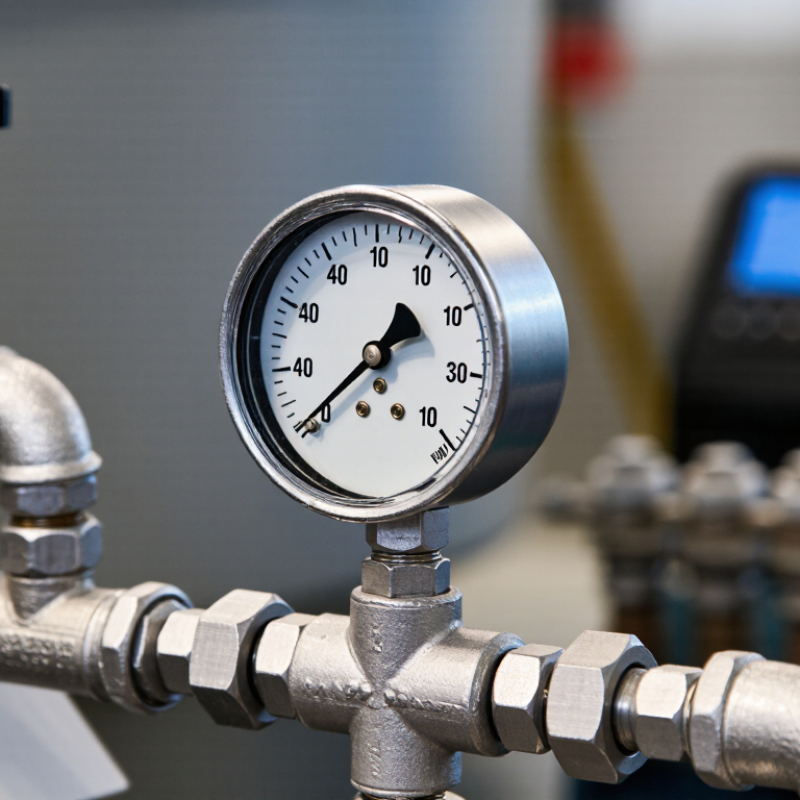
Pressure Gauges are small instruments with serious responsibilities. They show whether pressure remains within a safe operating range. A single reading can protect a boiler, pipeline, compressor, or medical gas system. For global buyers, the choice affects safety, maintenance costs, and production continuity.

Grand View Research reports that the global pressure gauge market is expanding steadily, supported by demand from oil and gas, chemicals, water treatment, and manufacturing. Its industry analysis also highlights rising interest in digital monitoring and improved measurement accuracy. Buyers should examine more than price. Accuracy class, dial visibility, connection size, wetted materials, temperature limits, and calibration documentation matter in real installations. A gauge that fits the catalogue may fail beside vibration, steam, corrosion, or sudden pressure changes.

Alexander Wiegand, CEO of WIKA, has stated, “Reliable pressure measurement begins with understanding the application.” That principle deserves attention. A gauge selected without process details is only an educated guess. Global purchasers should request traceable calibration certificates, relevant conformity documentation, and clear after-sales support. Standards such as ASME B40.100 and EN 837 can help compare performance, although compliance alone does not guarantee suitability. It is easy to overlook installation errors, especially when specifications cross languages and regions. The dial may look precise. The system may still be wrong. Careful supplier evaluation turns Pressure Gauges from inexpensive accessories into dependable safety and control instruments.
Why Are Pressure Gauges Important for Global Buyers?

What Is a Pressure Gauge and How Does It Work?

A pressure gauge measures the force exerted by a gas or liquid inside a system. For global buyers, it provides a visible reading during installation, operation, and maintenance. Most mechanical gauges use a sensing element, such as a Bourdon tube. When pressure enters the tube, it slightly straightens. A linkage transfers this movement to a pointer, which displays the pressure on a calibrated dial.

Simple, but not foolproof.

Gauge selection depends on pressure range, connection size, medium, temperature, and required accuracy. Always check the measurement unit, such as bar, psi, or kPa. A gauge rated too high may hide small pressure changes. One rated too low may suffer damage during pressure spikes. Process temperature can also affect readings and seal performance. Calibration matters. A new gauge is not automatically accurate forever. That assumption can fail in vibrating equipment or harsh environments.

Tips:

  • Verify the gauge range against normal working pressure.
  • Confirm the connection thread and dial orientation before ordering.
  • Ask for calibration records and material details when reliability is critical.
  • Compare the reading with a trusted reference gauge during inspection.
  • Also, leave space for pressure surges; real systems rarely behave perfectly.

Why Pressure Gauges Matter in Global Industrial Applications

Why Are Pressure Gauges Important for Global Buyers?

Pressure gauges matter because industrial systems rarely operate under forgiving conditions. A small reading error can affect pumps, valves, filters, and worker safety. In a processing plant, a needle moving from 6 to 8 bar may signal a blocked line. It may also indicate a damaged sensor. The gauge alone cannot explain everything.

Global buyers should match the gauge with the process, not just the connection size. Steam, compressed air, hydraulic oil, and corrosive chemicals require different wetted materials. Stainless steel may perform well in many environments, but it is not universally suitable. Temperature, vibration, pulsation, and humidity also influence accuracy. A gauge installed beside a hot pipe may need a siphon, diaphragm seal, or cooling element. Small details matter.

Calibration records provide useful evidence. Buyers should check accuracy class, pressure range, case protection, dial visibility, and connection standards. Traceable calibration supports maintenance teams across different countries and facilities. Standards such as ASME B40.100 or EN 837 can help, but compliance statements still deserve careful verification. A certificate is not proof of perfect field performance. Mounting errors, pressure spikes, and poor inspection habits can reduce reliability quickly. Sometimes, the overlooked impulse line causes the problem. That is an uncomfortable lesson. Regular comparison with a reference instrument helps reveal drift before production quality changes.

Why Pressure Gauges Matter in Global Industrial Applications

Pressure gauges provide a direct local indication of system pressure, helping operators verify safe operation, detect abnormal conditions, and select compatible equipment across different industrial environments.

The values show representative gauge full-scale ranges commonly encountered in industrial service. Actual requirements vary with system design, operating conditions, safety margins, temperature, and applicable standards.

Which Types of Pressure Gauges Suit Different Buyer Needs?

Pressure gauge selection should begin with the buyer’s real operating conditions, not the lowest quoted price. A Bourdon tube gauge suits general water, air, and hydraulic service. It is durable and easy to read. For corrosive liquids or low-pressure applications, a diaphragm gauge can provide better protection. Capsule gauges are often useful for very low gas pressures. Read the conditions carefully.

Differential pressure gauges serve buyers monitoring filters, pumps, and ventilation systems. They show the pressure difference between two points. This helps operators identify a blocked filter before airflow drops sharply. Digital gauges suit users needing clear readings, alarms, or stored measurements. However, they depend on battery life and correct calibration. That detail is sometimes overlooked.

Experienced buyers should check pressure range, connection size, wetted materials, temperature limits, accuracy, and protection rating. The normal working pressure should stay near the middle of the gauge scale. A gauge exposed to vibration may need a filled case or remote installation. Sanitary processing may require smooth, cleanable connections. I have seen projects fail because the connection thread was assumed, not verified. Keep it simple. Request calibration records and confirm whether testing follows a recognized standard. Even a highly accurate gauge becomes unreliable when installed with the wrong seal, excessive vibration, or poor visibility.

How to Evaluate Pressure Gauge Quality, Accuracy, and Safety

Why Are Pressure Gauges Important for Global Buyers?

How to Evaluate Pressure Gauge Quality, Accuracy, and Safety

Global buyers need more than a low purchase price. A pressure gauge is the operator’s visual warning near a pump, pipe, or vessel. It must remain credible under vibration, heat, and pulsation.

For accuracy, request the stated accuracy class, test range, and calibration certificate. EN 837-1 lists accuracy classes from 0.1 to 4. Smaller numbers indicate tighter permitted error. ASME B40.100 also defines accuracy grades and test conditions. Check whether accuracy applies across the full scale or selected points. This detail is often missed.

A 0–100 bar gauge with Class 1 accuracy may allow about ±1 bar under reference conditions. That difference matters near a relief setting. Calibration evidence should include test points, uncertainty, date, and traceability. NIST metrology guidance emphasizes documented uncertainty, not just a stamped certificate.

Safety checks should cover overpressure protection, case design, wetted materials, and connection integrity. Ask for proof-test records, leak checks, and material declarations. For hazardous process service, verify chemical compatibility and suitable pressure relief features. Temperature correction may be necessary outside the reference range.

The 2023 U.S. Census of Fatal Occupational Injuries recorded 5,283 workplace fatalities, although it does not isolate gauge-related events. Safety decisions still deserve measurable evidence. Visual inspection alone is weak. A clean dial proves little.

Transport can cause hidden drift. Buyers should sample incoming units against a calibrated reference and record deviations.

No checklist is perfect. Review failures, not only certificates.

What Should Global Buyers Check Before Purchasing Pressure Gauges?

Why Are Pressure Gauges Important for Global Buyers?

What Should Global Buyers Check Before Purchasing Pressure Gauges?

Before approving a pressure gauge, global buyers should verify the pressure range, accuracy class, dial size, and connection standard. A gauge operating near its maximum range may wear faster and provide less reliable readings. ASME B40.100 provides recognized guidance for pressure gauge construction, performance, and accuracy. It should guide the specification, not replace application testing.

Material compatibility needs careful attention. Stainless steel may suit corrosive environments, while a glycerin-filled case can reduce pointer vibration on a busy production line. Check the process medium, temperature, humidity, vibration, and mounting position. Small details matter.

Thread standards can also vary between regions, creating leaks or installation delays. Field technicians often discover that a “universal” connection is not universal enough.

Independent data also supports careful selection. Mordor Intelligence’s 2024 market analysis estimates the global pressure gauge market at about USD 1.27 billion in 2024, with continued growth expected through 2029.

This expanding demand increases product choices, but not necessarily product quality. Ask for calibration records, test points, material certificates, and traceability from an ISO/IEC 17025-accredited laboratory. The National Institute of Standards and Technology emphasizes traceability as a foundation for dependable measurement.

Buyers should also review the warranty and recalibration interval. A lower purchase price can become expensive after repeated replacements.

Blogs