
Top 10 Types of Exhaust Fans for Global Buyers
Choosing the right exhaust system begins with evidence, not attractive packaging. This guide, “Top 10 Types of Exhaust Fans for Global Buyers,” examines airflow, noise, energy use, installation conditions, and maintenance demands. These details matter in kitchens, bathrooms, factories, warehouses, and commercial buildings.
The U.S. Environmental Protection Agency reports that indoor pollutant levels can be two to five times higher than outdoor levels, and sometimes much higher. That finding gives exhaust ventilation a practical purpose: removing moisture, odors, heat, and airborne contaminants at their source. ASHRAE Standard 62.1 and Standard 62.2 provide widely recognized ventilation guidance for commercial and residential spaces. However, a fan’s rated airflow is not its real performance. Duct length, bends, filters, louvers, and pressure resistance can reduce delivery. A 1,000-cubic-foot-per-minute fan may deliver far less after installation. That is easy to overlook.
Joseph G. Allen, an indoor-air-quality researcher at Harvard T.H. Chan School of Public Health, has said, “Ventilation is one of the most important tools we have to improve indoor air quality.” His statement supports a careful buying process, especially for global projects with different climates and electrical standards. The following overview compares axial, centrifugal, mixed-flow, roof-mounted, wall-mounted, explosion-resistant, and other major designs. It also considers practical certification and service issues. Not every popular model is suitable. Sometimes, the cheapest option becomes the loudest and most expensive choice. This guide is not perfect; performance still depends on professional sizing, local codes, and honest site measurements. For buyers evaluating Exhaust Fan Exhaust Fan solutions, those limitations deserve attention before any purchase decision.
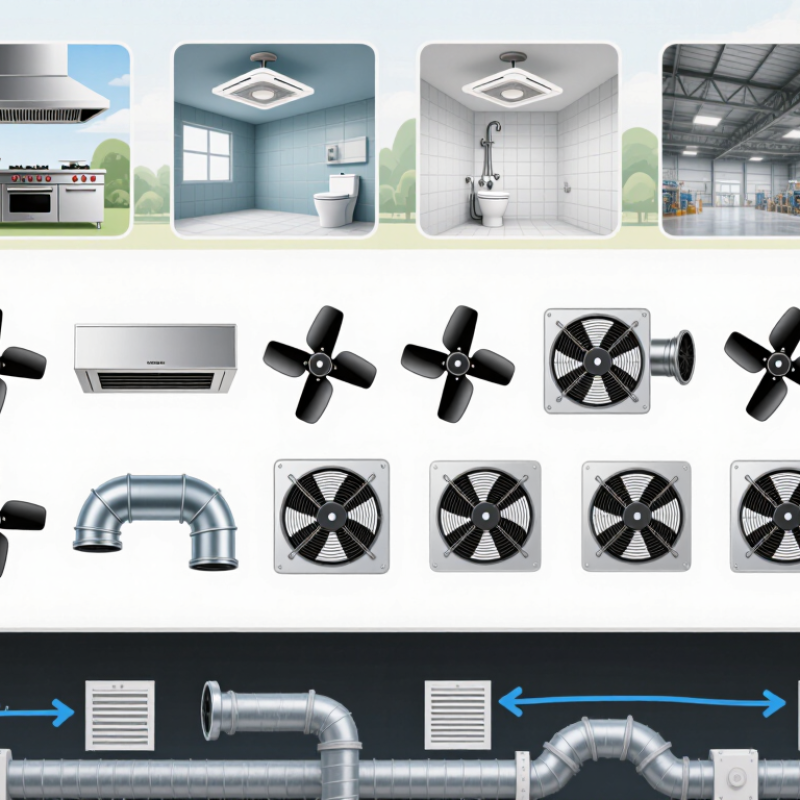
## What Exhaust Fans Are and How They Work
What Exhaust Fans Are and How They Work
An exhaust fan removes stale, humid, or contaminated air from an enclosed space. Its motor rotates an impeller, creating a pressure difference. Air then travels through grilles, ducts, and an external outlet. Replacement air enters through doors, windows, or designed intake vents. Without makeup air, airflow can weaken and doors may become difficult to open.
Fan performance depends on more than motor wattage. Buyers should check airflow, measured in m³/h or CFM, plus static pressure, noise, efficiency, and duty cycle. A short duct needs less pressure than a long duct with several bends. The U.S. EPA reports that indoor pollutant levels can be two to five times higher than outdoor levels. The International Energy Agency’s Buildings 2023 report also states that buildings use about 30% of global final energy. Efficient ventilation matters, but energy savings can be overstated when installation losses are ignored.
Tips: Match the fan to the room volume and required air changes. Confirm duct diameter before ordering. Select corrosion-resistant materials for bathrooms, kitchens, and coastal sites. Check the ingress protection rating for wet locations. A backdraft damper helps prevent reverse airflow, though it may add resistance. Test the installed airflow, not only the catalog rating. That small distinction often exposes poor design.
Top 10 Types of Exhaust Fans for Global Buyers
What Exhaust Fans Are and How They Work
| No. | Exhaust Fan Type | How It Works | Typical Applications | Typical Airflow Range | Main Advantages | Important Buying Considerations |
|---|---|---|---|---|---|---|
| 1 | Wall-Mounted Propeller Fan | A rotating propeller moves air directly through a wall opening, usually exhausting air from one side to the other. | Warehouses, workshops, garages, agricultural buildings, and large utility areas. | 1,000–30,000 m³/h | High airflow, simple construction, easy installation, and relatively low purchase cost. | Best for short air paths and low-resistance systems; not ideal for long ducts or high static pressure. |
| 2 | Axial Duct Fan | Axial blades move air parallel to the fan shaft through a connected duct system. | Commercial ventilation, factories, tunnels, greenhouses, and general supply or exhaust systems. | 500–25,000 m³/h | Compact design, strong air volume, and suitability for straight duct runs. | Check pressure performance carefully because airflow can decrease significantly in restrictive ductwork. |
| 3 | Centrifugal Exhaust Fan | An impeller draws air into the center and turns it outward, creating higher pressure for ducted exhaust. | Industrial plants, commercial kitchens, laboratories, workshops, and buildings with long duct systems. | 500–20,000 m³/h | Handles higher resistance, filters, bends, and longer ducts better than many axial designs. | Usually larger, noisier, and more energy-intensive than simple propeller fans at comparable airflow. |
| 4 | Mixed-Flow Inline Fan | A mixed-flow impeller combines axial and centrifugal airflow characteristics to provide moderate pressure and high volume. | Residential, retail, office, restaurant, and light-commercial duct ventilation. | 200–5,000 m³/h | Good balance of compactness, airflow, pressure capability, and relatively low noise. | Confirm duct diameter, operating pressure, access for maintenance, and controller compatibility. |
| 5 | Roof-Mounted Exhaust Fan | The fan is installed on the roof and discharges contaminated or warm air directly outdoors. | Factories, warehouses, commercial buildings, kitchens, and industrial process areas. | 1,000–40,000 m³/h | Saves indoor floor space and can remove heat, moisture, smoke, and airborne pollutants efficiently. | Roof structure, weather protection, waterproof flashing, vibration control, and safe maintenance access are essential. |
| 6 | Bathroom and Toilet Exhaust Fan | A small motor-driven impeller extracts humid or odorous air through a wall, ceiling, or short duct. | Bathrooms, toilets, laundry rooms, small utility rooms, and residential wash areas. | 50–350 m³/h | Compact, easy to operate, and effective for controlling everyday moisture and odors. | Look for backdraft protection, suitable noise rating, humidity control options, and the correct room ventilation rate. |
| 7 | Kitchen Range Hood Exhaust Fan | The fan captures cooking vapors near the source and exhausts grease-laden air through a filter and duct. | Residential kitchens, food-service areas, restaurants, and light commercial cooking spaces. | 300–2,000 m³/h | Removes smoke, steam, odors, and airborne grease when correctly sized and installed. | Verify grease filtration, fire-safety requirements, duct material, make-up air, and local commercial-kitchen codes. |
| 8 | Smoke Exhaust Fan | A high-temperature-rated fan removes smoke and hot gases during a fire or other emergency condition. | Car parks, stairwells, atriums, tunnels, industrial buildings, and smoke-control systems. | 3,000–60,000 m³/h | Supports smoke management and helps maintain tenable evacuation or firefighting conditions when part of a compliant system. | Temperature-time rating, emergency power, fire controls, testing, certification, and local building regulations are critical. |
| 9 | Explosion-Protected Exhaust Fan | The fan is designed to reduce ignition risks in areas where flammable gases, vapors, or dust may be present. | Chemical facilities, paint rooms, fuel-handling areas, battery rooms, and selected process zones. | 500–15,000 m³/h | Can be specified for hazardous environments with suitable electrical and mechanical protection. | Hazardous-area classification, temperature class, gas or dust group, grounding, materials, and certification must match the site. |
| 10 | Heat-Recovery Exhaust Unit | It exhausts stale indoor air while transferring part of its heat or cooling energy to incoming fresh air through a heat exchanger. | Energy-efficient homes, offices, schools, healthcare facilities, and tightly sealed commercial buildings. | 100–5,000 m³/h | Improves indoor air quality while reducing ventilation-related heating or cooling losses. | Consider heat-recovery efficiency, frost protection, filter maintenance, condensate drainage, pressure balance, and climate. |
Selection note: Actual airflow depends on fan speed, system resistance, duct length, filters, grilles, temperature, and installation conditions. Buyers should compare performance at the required static pressure rather than relying only on free-air airflow figures.


