
How to Choose Black Rectangular Hollow Section?

Choosing a Black Rectangular Hollow Section involves more than selecting a dark finish and a neat, straight profile. The right choice depends on how the section will be used, supported, cut, and joined. A frame in a sheltered workshop may need different specifications from an exposed gate or structural assembly. Start with the required outer dimensions and wall thickness. Then confirm the steel grade and section length against the project drawings.

Appearance can be misleading. “Black” may describe the surface supplied, so ask whether it is a mill finish, painted, or otherwise coated. Check product documentation for dimensions, tolerances, grade, and any applicable standards. These details matter when sections must align with plates, bolts, or adjoining members. Small differences show up quickly at a tight-fitting joint. They are easy to overlook.

Consider loads, span, restraint, and the finished environment before settling on a size. A qualified engineer should verify structural suitability; a catalogue table alone cannot account for every connection or support condition. For fabrication, check cutting requirements, weld access, and whether the surface needs preparation or extra protection. Ask the supplier for traceable documentation, especially when consistent quality matters. Compare delivered specifications, not just price per length. If a detail remains unclear, pause and confirm it. That may feel cautious, but replacing an unsuitable section later is rarely simple.
How to Choose Black Rectangular Hollow Section?

Understanding Black Rectangular Hollow Section and Its Uses

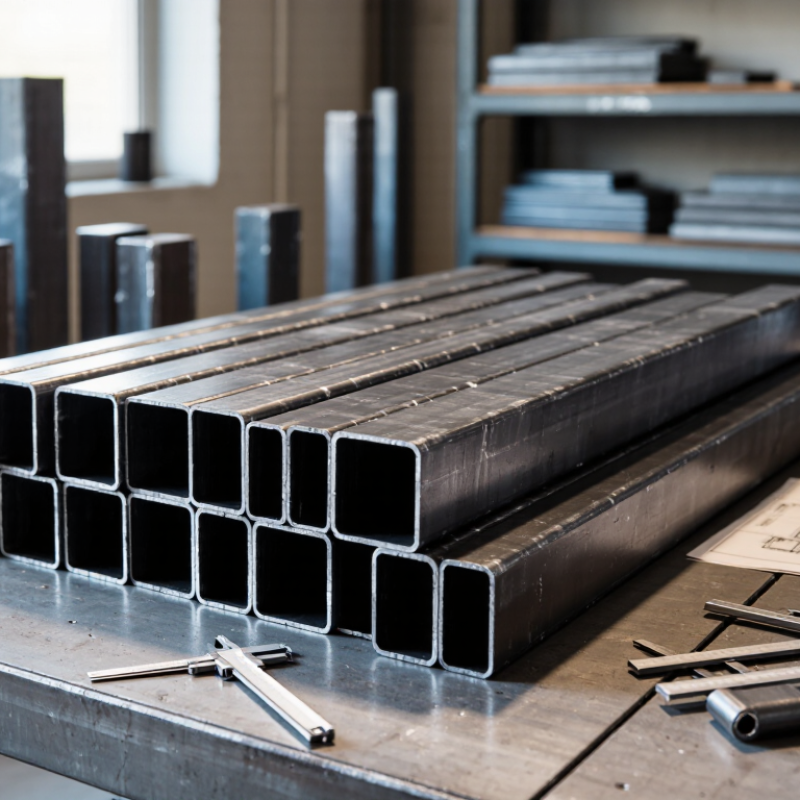
Black rectangular hollow section (RHS) is a welded steel tube with a rectangular cross-section and a dark, usually uncoated mill finish. Its flat faces are convenient for bolted connections, while the hollow centre keeps weight lower than a solid bar of similar outside dimensions. It is used for building frames, gates, equipment supports, trailers, and furniture. The finish is not automatically corrosion protection. Outdoors, moisture can collect at cut ends and welds.

RHS size is described by outside width, outside depth, and wall thickness. A 100 × 50 × 3 mm section, for example, has unequal sides and a nominal 3 mm wall. Check the product standard, steel grade, actual dimensions, and fabrication requirements before specifying it. The World Steel Association’s World Steel in Figures 2024 reports 1,892.2 million tonnes of crude steel production worldwide in 2023. That scale gives useful context, but it does not prove that a particular RHS size can carry a given load.

Match the section to its job. A deeper side can improve stiffness when oriented correctly, but joints and unsupported length also matter. Ask for mill test documentation and inspect the section for dents, twist, and uneven weld seams. For structural use, have loads and connections checked by a qualified engineer. I would not choose by appearance alone. A small mismatch in wall thickness can matter.

Identifying the Required Size, Wall Thickness, and Steel Grade

Choosing black rectangular hollow section starts with the load, span, and connection details—not appearance. Record the outside width and depth, then check whether the section fits the available space and supports the expected bending and compression. For example, a 100 × 50 mm section may fit a frame, but its capacity changes with wall thickness and orientation. Black typically describes the mill-finish surface, not the steel grade; confirm the finish and corrosion protection needed for the installation.

Wall thickness affects strength, weight, weld preparation, and cost. Avoid selecting the thickest option by default. Check design loads and local buckling with a qualified structural professional, using the applicable design code. ASTM A500/A500M lists minimum yield strengths of 315 MPa for rectangular Grade B tubing and 345 MPa for Grade C. These are material minimums, not allowable design stresses. One detail is easy to miss: actual dimensions and thickness tolerances can affect fit-up, so confirm the supplier’s specification before detailing connections.

Tips: State dimensions as width × depth × wall thickness, in millimetres or inches. Include length, grade, finish, and required tolerances on the order. Measure twice. If the section will be exposed outdoors, consider drainage and a suitable protective coating; paint alone may not protect cut ends or enclosed joints.

How to Choose Black Rectangular Hollow Section? — Identifying the Required Size, Wall Thickness, and Steel Grade

Compare section sizes and wall thicknesses against the estimated mass per metre shown. These values are calculated from nominal dimensions using a sharp-corner approximation, so actual product weights may differ because of corner radii and manufacturing tolerances. For EN 10219 hollow sections with wall thickness up to 16 mm, common minimum yield strengths are 235 MPa for S235JRH, 275 MPa for S275J0H, and 355 MPa for S355J2H. Confirm the required grade, dimensions, design loads, and applicable standard for your project.

Comparing Surface Finish, Coating, and Corrosion Protection

How to Choose Black Rectangular Hollow Section?
Comparing Surface Finish, Coating, and Corrosion Protection

“Black” describes the steel’s appearance, not its corrosion resistance. Hot-rolled black RHS often retains mill scale, which can hide early rust and provide an unreliable base for paint. A black finish can look reassuring. It may not be. Check the surface for loose scale, oil, weld spatter, and damaged edges before specifying a coating.

The environment should guide protection. The 2016 NACE International IMPACT study estimated global corrosion costs at US$2.5 trillion annually, about 3.4% of global GDP. For coating selection, ISO 12944 classifies expected durability from low, under seven years, to very high, over 25 years. These are planning ranges, not warranties. A sheltered indoor frame and a coastal handrail need different systems.

For outdoor sections, compare a prepared steel surface with a compatible primer-and-topcoat system or hot-dip galvanizing. Ask for the preparation method, specified film thickness, and inspection records—not just a colour sample. On RHS, water can collect at cut ends, welds, and poorly drained cavities. Small detail, big consequence. Confirm venting and drainage before galvanizing, and repair coating damage after cutting or installation. One limitation remains: even a sound specification can fail if the site team skips surface preparation.

How to Choose Black Rectangular Hollow Section? - Comparing Surface Finish, Coating, and Corrosion Protection
Finish or protection option Typical appearance Typical coating thickness Corrosion protection Advantages Limitations and suitable use
Black mill finish (uncoated) Dark grey to black surface, often with mill scale; appearance and surface condition can vary. No applied protective coating. Low when exposed to moisture or weather. Mill scale is not a dependable long-term corrosion barrier. Usually economical and readily available; can be prepared for a specified coating system. Best for dry, indoor conditions or where a separate protection system will be applied. Clean and prepare the surface before painting; remove loose scale, rust, oil, and contaminants.
Shop-applied primer Usually red, grey, or another primer color; not necessarily black. Often approximately 20–75 μm dry film thickness (DFT), depending on the primer and specification. Limited to moderate; intended mainly as temporary protection or as the base for a compatible paint system. Can reduce flash rust during storage and handling and provide a base for later coating. A primer alone may not provide durable outdoor protection. Confirm compatibility with the finishing coats, and check whether the primer must be removed from weld areas.
Zinc-rich primer with paint topcoats Primer is commonly grey; the final color depends on the chosen topcoat. A complete multi-coat system is commonly around 150–300 μm DFT; the specified build varies with exposure and product selection. Moderate to high when correctly specified, applied to properly prepared steel, and maintained. Provides a repairable barrier system; suitable for many fabricated structures and can be applied in a range of colors. Performance depends on surface preparation, film thickness, application quality, and maintenance. Edges, welds, and damaged areas need particular attention.
Hot-dip galvanizing Typically silver-grey; the surface may be bright, matte, or spangled. Often approximately 45–85 μm or more, depending on steel thickness and the applicable specification. High for many outdoor exposures because the zinc coating provides a barrier and sacrificial protection. Coats accessible internal and external surfaces of properly vented hollow sections; generally offers durable protection with relatively low routine maintenance. The section must be designed with suitable vent and drain openings for galvanizing. Welding or cutting after galvanizing damages the coating locally and requires repair. Appearance can vary.
Powder coating Uniform colored finish; black is commonly available. Often approximately 60–120 μm, depending on the powder and specification. Moderate to high when pre-treatment, coverage, and curing are appropriate for the exposure. Provides an even decorative finish and a tough surface; often used for finished products and components. Requires controlled pre-treatment and curing facilities. Damage and cut edges can expose steel; field repairs may not match the original finish. Hollow-section interiors may not receive the same protection.
Duplex system: galvanizing plus paint Painted color over a galvanized base; black topcoats are possible. Combines the specified zinc coating with a paint system, often approximately 100–250 μm DFT of paint in addition to the zinc layer. High when the paint system is compatible with the galvanized surface and applied and maintained correctly. Adds color and a further barrier; may extend service life compared with either system alone in suitable conditions. Requires correct preparation of the galvanized surface and compatible coatings. More steps and inspection are needed than for a single finish.

Selection note: Thicknesses are indicative ranges, not guaranteed values. Specify protection based on the service environment, design life, fabrication sequence, and applicable project requirements. For painted systems, a defined surface-preparation grade and coating specification are essential; for galvanizing, confirm section venting and drainage before fabrication.

Checking Standards, Load Requirements, and Supplier Specifications

How to Choose Black Rectangular Hollow Section?

Start by identifying the standard required by the project, not just the section size. Standards can define dimensions, wall-thickness tolerances, steel grade, and testing requirements. Confirm which standard applies to your location and intended use. A tube labelled “black” usually describes its uncoated, dark mill-finish surface; it does not confirm its grade or structural capacity. Check the documentation.

Load requirements need real project details. Note the section’s span, support conditions, load direction, and connection method. A long beam may be limited by deflection before it reaches its strength limit. For example, a 100 × 50 mm section can behave differently when its wider face is turned vertically. Small details matter. Have a qualified engineer verify the selected size and wall thickness, especially where loads are uncertain. Do not guess from appearance.

Ask suppliers for the exact outside dimensions, nominal and minimum wall thickness, grade, applicable manufacturing standard, and available lengths. Request inspection documents or test certificates that match the supplied batch, along with clear tolerance information. Check whether the quoted weight is theoretical or measured; the difference can affect ordering and fabrication. Also confirm surface condition, packaging, and cut-length accuracy. A polished specification sheet helps, but it cannot replace batch traceability. I have seen small paperwork gaps create avoidable delays, so verify them before placing the order.

Selecting the Right Section for Fabrication and Installation

How to Choose Black Rectangular Hollow Section?

Selecting the right black rectangular hollow section starts with the fabrication and installation details. Check the specified outside dimensions, wall thickness, steel grade, and section length against your drawings. A tube that looks close can still cause trouble at a joint. Thin walls may distort during welding, while thicker sections add weight and can make handling harder. There is no universally perfect choice. Confirm whether “black” means an uncoated mill finish, and ask about surface condition before planning paint or other protection.

Tips: Allow for cutting and fit-up tolerances. Check that mitred ends meet cleanly, and leave practical access for welds, clamps, and fasteners. A quick trial assembly can reveal alignment problems before the full frame is made. Small gaps matter.

For installation, consider how the section will be lifted, positioned, and secured. Long pieces can flex during handling, even when the finished assembly is rigid. Protect cut edges and drilled holes if the project requires corrosion protection. Keep dimensions and material certificates with the job record, then compare the delivered section with the purchase specification. It is easy to focus on strength alone; in practice, finish, access, and a workable installation sequence deserve equal attention. For load-bearing designs, have a qualified professional verify the section and connections for the actual loads and support conditions.

Blogs