How to Choose the Right MCCB Breaker for Your Business Needs?
Choosing the right MCCB breaker for your business is critical. With so many options available, it can be overwhelming. Experts emphasize the importance of understanding the specific needs of your operations.
John Smith, a senior electrical engineer with over 20 years of experience, says, "The right MCCB breaker can save your business from unexpected outages." This statement highlights the role of MCCB breakers in ensuring operational continuity.
Selecting an MCCB breaker involves evaluating your power requirements. You need to consider the voltage, current ratings, and application type. Each detail matters and can impact your decision. If your choice is wrong, it might lead to inefficiencies. Knowing your business's unique electrical load is essential. Taking time to analyze these factors can lead to better outcomes. In the end, choosing the right MCCB breaker is not just about saving costs, but also about enhancing reliability.
Understanding MCCB Breakers and Their Functionality
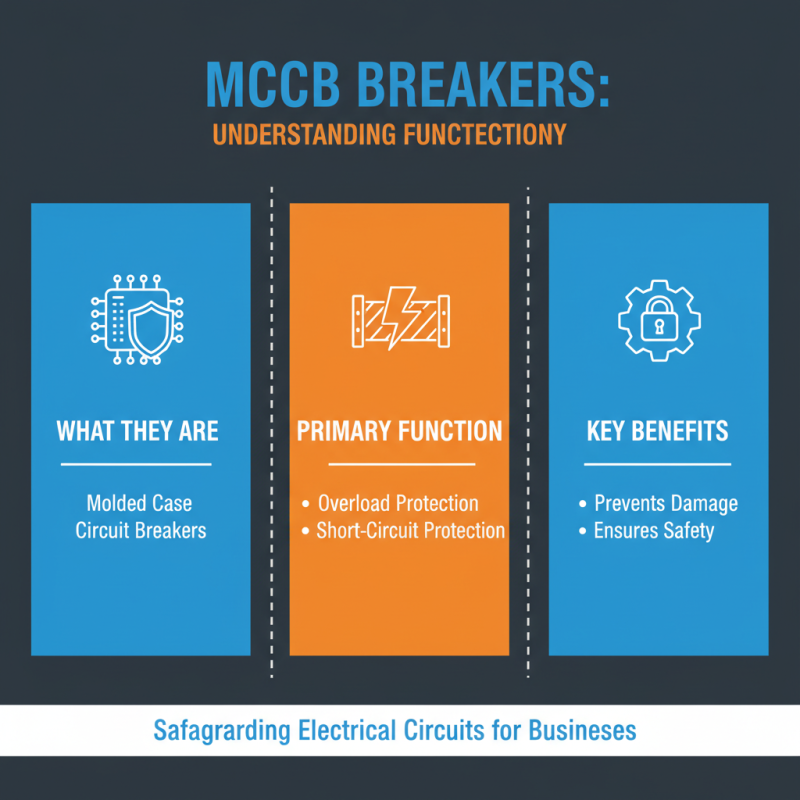
MCCB, or Molded Case Circuit Breakers, are crucial for safeguarding electrical circuits. They provide overload and short-circuit protection, essential for businesses of all sizes. Understanding their functionality helps in selecting the right type for your needs. MCCBs can detect faults in an electrical system. When they sense a problem, they cut off the power. This feature prevents potential damage and ensures worker safety.
Selecting an MCCB isn't always straightforward. Factors such as amperage rating and trip settings matter significantly. Many businesses overlook these details. For example, a breaker may trip too often if it's not rated for the specific load. This inappropriate choice can lead to unnecessary downtime. Conversely, an oversized breaker may fail to protect against faults effectively.
Additionally, considering the environment is vital. Some MCCBs are designed for harsh conditions, while others may require a controlled environment. Dust, moisture, and temperature variations can affect performance. Ensuring the right fit not only enhances safety but can also improve the lifespan of the breaker. Balancing these factors demands careful thought and expertise. Take the time to analyze your specific requirements thoroughly.
Identifying Your Business's Electrical Load Requirements
Choosing the right MCCB breaker requires understanding your business's electrical load requirements. Start by assessing the total load your equipment and appliances will draw. This gives you a clear picture of the necessary protection. Different environments need different solutions, especially for high-demand industries.
Consider the peak load demand of your business. It's essential to account for potential future growth. This foresight prevents the need for frequent upgrades. Analyze the starting load of motors and other devices. These may require higher initial current, which is crucial for selecting the right MCCB.
Tip: Keep a detailed list of all devices and their power ratings. Review this list regularly to ensure compliance with load changes.
Another key point is to consider the ambient conditions of your installation. Heat, moisture, and dust can affect performance. The chosen breakers need to withstand these conditions.
Tip: Consult with an electrical expert to confirm your calculations and selections. Their insight adds validity to your choices. Avoiding common pitfalls is vital for efficiency and safety.
Evaluating the Key Features of MCCB Breakers
When selecting an MCCB breaker for your business, it’s essential to evaluate its key features. MCCBs, or Molded Case Circuit Breakers, offer protection against overloads and short circuits. They are a crucial component in industrial and commercial electrical installations. According to a report by Energy Research Institute, over 68% of electrical failures in industries are linked to inadequate circuit protection.
One crucial feature to consider is the current rating. Ensure it suits your electrical load requirements. Another essential aspect is the trip curve type, which determines the response time to overloads. For instance, a type B curve suits residential applications, while a type C curve is better for commercial use. The choice impacts overall operational efficiency.
Tips: Always assess the installation environment. Factors like temperature and humidity can affect performance. Additionally, if your load varies significantly, consider adjustable trip settings. This flexibility can enhance safety and efficiency.
Another aspect is the maintenance accessibility of the breaker. Some units may require special tools for servicing. A study by the International Electrotechnical Commission found that 25% of businesses faced downtime due to maintenance issues. Prioritize models that allow easy access for repairs or inspections. This consideration can save time and resources in the long run.
How to Choose the Right MCCB Breaker for Your Business Needs? - Evaluating the Key Features of MCCB Breakers
| Feature |
Description |
Importance |
| Absorbed Current Capacity |
The maximum current the MCCB can handle without tripping. |
Crucial for determining if the MCCB can manage your specific load requirements. |
| Breaking Capacity |
The ability to interrupt fault currents. |
Essential for safety to prevent equipment damage during faults. |
| Tripping Mechanism |
Type of operation (thermal, magnetic, or electronic) that determines when the circuit opens. |
Affects response time and sensitivity to overloads. |
| Poles |
Number of poles required (single, double, three, or four). |
Determines the number of circuits the MCCB can protect. |
| Temperature Rating |
The operational temperature range of the MCCB. |
Important for ensuring reliable operation in specific environments. |
| Mounting Type |
How the MCCB is installed (panel-mounted, remote-mounted). |
Affects installation process and space considerations. |
Comparing Different MCCB Brands and Models
When selecting an MCCB (Molded Case Circuit Breaker), comparing different brands and models is essential. A report by Electrics Insights states that the global MCCB market is expected to grow by 10% annually through 2025. This growth reflects increasing demand for reliable electrical systems across various industries.
Different models offer varying features. Some are designed for high short-circuit current ratings, enhancing safety in industrial applications. Others focus on compact designs, suitable for limited space in commercial settings. Reliability ratings can differ significantly. A study by Power Management Associates found that only 75% of reported incidents could be traced back to faulty breakers. Understanding these metrics is crucial for making an informed decision.
An analysis of recent customer feedback shows that installation complexities can vary widely. Many users report challenges with specific models due to unclear instructions. This inconsistency can lead to unnecessary downtime. Ultimately, it is vital to evaluate both performance metrics and user experience to align choice with business needs.