2026 How to Choose the Right Vacuum Circuit Breaker for Your Needs?
Choosing the right vacuum circuit breaker can significantly impact the efficiency and reliability of your electrical systems. Industry expert Dr. Emily Johnson, a respected authority in circuit protection technologies, says, "The correct choice of a vacuum circuit breaker can prevent unnecessary downtimes."
Vacuum circuit breakers play a critical role in safeguarding electrical networks. Their efficiency lies in their ability to interrupt electric currents effectively, ensuring safety and reliability. Understanding your specific needs is essential. The right selection can enhance operational performance and extend the lifespan of your equipment.
However, navigating the options available can be complicated. It’s not just about choosing a brand or model; it involves a thorough assessment of system requirements. Factors such as load capacity, operational environment, and maintenance needs must be considered. If overlooked, these factors can lead to inefficiencies and increased costs. Attempting to simplify the selection process may lead to mistakes that could have been avoided with careful consideration.

Understanding the Basics of Vacuum Circuit Breakers
Vacuum circuit breakers (VCBs) play a crucial role in electrical distribution systems. They are designed to interrupt faults with minimal energy loss. However, choosing the right VCB requires a solid understanding of their principles and performance metrics. The technology utilizes a vacuum to extinguish the arc during operation. This process ensures longer life spans and reduced maintenance. According to a recent market report, the adoption of vacuum circuit breakers is expected to grow by 5.8% annually through 2026. This figure emphasizes the importance of selecting suitable breakers for various applications.
Key specifications include voltage ratings, interrupting capacity, and operational life. It's vital to consider the environment in which the VCB will operate. In industrial settings, for instance, dusty or humid conditions may impact performance. Research indicates that VCBs can last up to 10,000 operations under optimal conditions. Yet, factors like thermal cycling and mechanical wear may reduce this lifespan. Engaging with industry experts can provide invaluable insights into your specific requirements.
Moreover, installation plays a significant role in the efficacy of VCBs. Improper installation can lead to premature failures. Industry data suggests that about 15% of circuit breaker failures are directly linked to installation errors. Understanding these nuances can help businesses make informed decisions regarding their electrical systems. Balancing technical specifications with reliable installation practices is crucial in ensuring optimal performance.
2026 How to Choose the Right Vacuum Circuit Breaker for Your Needs? - Understanding the Basics of Vacuum Circuit Breakers
| Parameter |
Description |
Importance |
| Rated Voltage |
The maximum voltage the circuit breaker can handle. |
High |
| Rated Current |
The maximum current the breaker can carry without tripping. |
High |
| Breaking Capacity |
The maximum fault current that the breaker can interrupt. |
Critical |
| Pole Configuration |
The number of poles required for the respective application. |
Medium |
| Operating Mechanism |
Type of mechanism used to open and close the contacts. |
Medium |
| Environment |
Conditions like humidity, temperature, and presence of dust. |
High |
Key Factors to Consider When Selecting a Vacuum Circuit Breaker
When selecting a vacuum circuit breaker (VCB), several key factors warrant consideration. The voltage rating is crucial. According to the IEEE, VCBs often serve in medium-voltage applications, typically ranging from 1 kV to 36 kV. Furthermore, the interrupting capacity must align with the specific application's short-circuit current requirements. Selecting a breaker with inadequate capacity can result in severe equipment damage or failure.
Another vital aspect is the installation environment. VCBs excel in industrial and commercial settings due to their compact design and reliability. However, moisture or extreme temperatures may affect their performance. Data from Electra, a leading electrical engineering journal, indicates that proper environmental conditions boost the longevity of circuit breakers significantly.
**Tip:** Always check the manufacturer's specifications for environmental ratings.
Maintenance frequency also influences the choice of a VCB. Regular inspections can prolong the lifespan of the equipment, but the need for accessibility to perform these checks may dictate your choice. It’s worth noting that complex systems can sometimes lead to oversights in maintenance needs. Many users overlook this aspect, risking unexpected failures.
**Tip:** Keep a maintenance log to track performance and issues.
A final reflection on cost considerations is necessary. While it may be tempting to prioritize lower prices, investing in quality and reliability often yields long-term savings. A cheaper VCB might cost more in the long run due to frequent failures.
Factors Affecting the Selection of Vacuum Circuit Breakers
Evaluating Your Electrical System Requirements for Circuit Breakers
When selecting a vacuum circuit breaker, assessing your electrical system requirements is essential. Start by analyzing the system's voltage levels and expected load currents. Consider the fault levels you might encounter. Understanding these factors will help narrow down your options.
Tips: Determine if your system has transient voltage spikes. This can affect breaker performance. Evaluate the environmental conditions too. Dust and humidity can impact a breaker's reliability.
Next, think about the specific application of your circuit break. Is it for industrial facilities or commercial properties? Understanding your purpose can significantly impact your choice. Additionally, plan for future expansions. Your needs might change over time, so select a breaker that can adjust to your growing demands.
Tips: Research the breaking capacity required for safety. Inadequate capacity can lead to failure during a fault. It’s crucial to ensure your breaker meets these specifications. Sometimes, the hardest part is knowing what to expect as your needs evolve.
Comparing Different Types of Vacuum Circuit Breakers
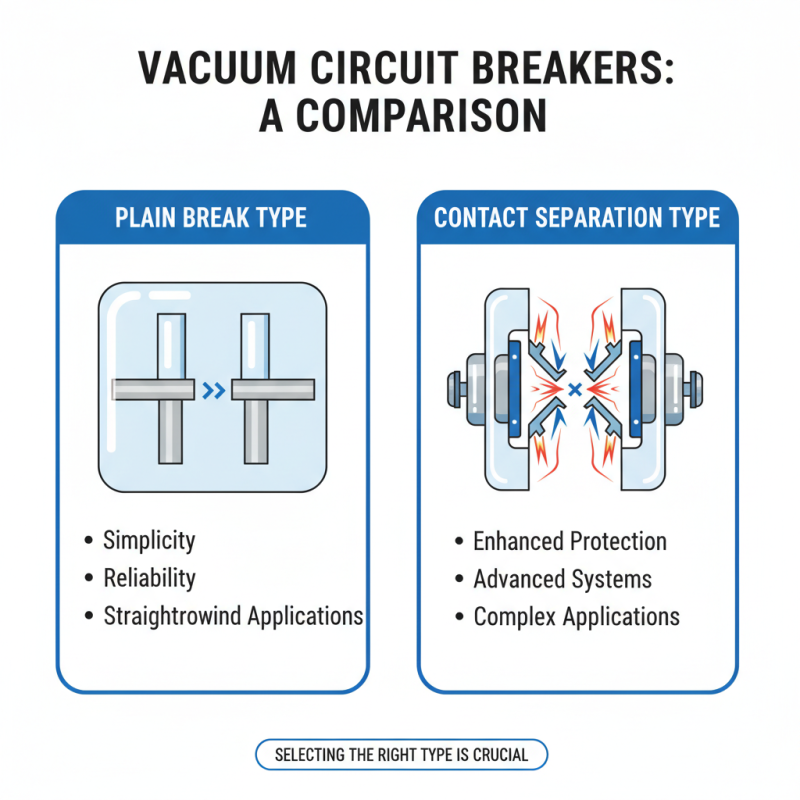
When selecting a vacuum circuit breaker, it's essential to understand the various types available. Each type has unique features and applications. For instance, there are plain break type and contact separation type vacuum circuit breakers. The plain break type is known for its simplicity and reliability, making it suitable for straightforward applications. However, this type might lack the enhanced protection some systems demand.
Another option is the contact separation type. This design allows for more precise control and connection management. It is particularly useful in environments with fluctuating loads. Such breakers can adapt better to unexpected changes, which can be invaluable. Still, they tend to be more complex and may require more costly maintenance.
Choosing the right vacuum circuit breaker involves evaluating your needs. Consider factors like the operational environment and load variations. Take time to analyze each option. Not every solution fits every situation. Rushed decisions could lead to inefficiencies or potential risks. It's crucial to weigh the pros and cons thoughtfully.
Maintenance and Safety Considerations for Vacuum Circuit Breakers
Vacuum circuit breakers (VCBs) play a critical role in electrical safety. Regular maintenance is essential for optimal performance. Inspections should focus on contact wear, insulation integrity, and the operating mechanisms. Keeping the breaker clean helps prevent unintended failures. Dust and moisture can cause problems, so ensure environments remain suitable.
Safety is paramount when handling VCBs. Always follow lockout/tag-out procedures during maintenance. Understand the specific operating parameters of your VCB. Some components, like the vacuum bottles, can wear out without visible signs. Replace or test them periodically to avoid surprises. Staying educated on manufacturer guidelines can enhance reliability.
Remember that while VCBs are robust, they aren't infallible. Unexpected faults can arise, leading to system outages. Training staff in troubleshooting and emergency response is crucial. Creating a culture of proactive maintenance can help mitigate risks. Reflecting on past incidents provides valuable lessons that improve overall safety.