
China Top Granite Tri Square Ruler Supplier?
Choosing a China top supplier for a granite tri-square ruler requires more than comparing catalogue prices. The tool must deliver stable squareness, clean reference faces, and repeatable measurements on the workshop floor. Its black granite body should resist corrosion, while calibrated edges should remain dependable beside a surface plate.
Industry reports show why precision tools deserve closer attention. Grand View Research estimates the global industrial metrology market will continue expanding through this decade, driven by automotive, aerospace, and advanced manufacturing demand. However, most published reports do not isolate the granite tri-square ruler category. That limitation matters. Buyers should examine evidence, not only market forecasts.
ASME B89.3.7 provides recognized guidance for granite surface plates, including flatness and repeatability considerations. ISO/IEC 17025 accreditation can also support confidence in calibration results. Ask for inspection records, material specifications, tolerance tables, and photographs of the finished reference faces. A supplier with a controlled granite workshop should explain curing, grinding, lapping, and final verification clearly.
Quality expert W. Edwards Deming offered a useful warning: “Without data you’re just another person with an opinion.” The lesson applies here. A polished ruler is not automatically accurate. China has capable manufacturers, but quality can vary between factories and batches. Some product pages remain vague. That is uncomfortable, yet worth admitting.
A strong supplier should provide traceable reports, practical packaging, and responsive technical support. Check the details. A one-degree error may look invisible, but it can distort a machinist’s layout line by several millimeters across a large workpiece. This guide compares supplier capability, verification methods, customization, and long-term purchasing reliability.
What Is a Granite Tri Square Ruler?
What Is a Granite Tri Square Ruler?
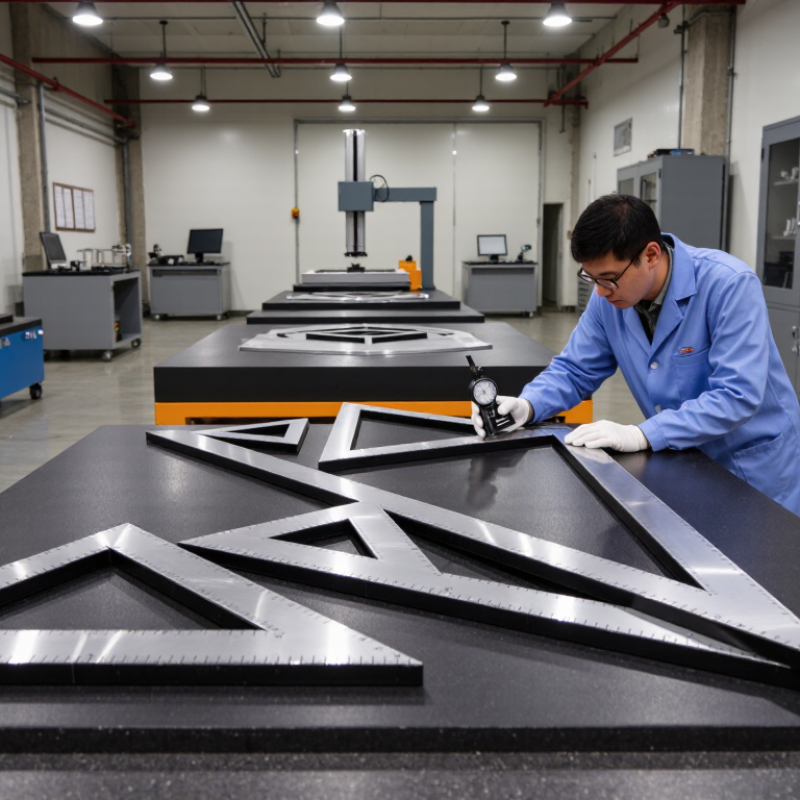
A granite tri square ruler is a precision inspection tool with three mutually perpendicular faces. It checks 90-degree relationships between machine parts, fixtures, and reference surfaces. Unlike a steel square, granite resists rust, magnetic influence, and dimensional change from ordinary workshop temperatures. Its dense structure also reduces vibration during layout and inspection work.
In practical use, an operator places the tri square on a certified granite surface plate. A feeler gauge, dial indicator, or optical method then checks contact deviation. ISO 8512-2 identifies granite surface plates as reference equipment requiring controlled flatness and calibration. NIST measurement guidance also stresses environmental control, repeatable contact, and traceable standards. These details matter. Dust can create a false gap.
Market evidence supports this growing focus on accuracy. Grand View Research’s 2024 dimensional metrology analysis forecasts continued market growth through 2030, driven by tighter manufacturing tolerances and automated inspection. However, a larger metrology market does not guarantee better results. The instrument still needs stable storage, careful cleaning, and periodic verification. Granite can chip at an edge. It is not indestructible. I would also avoid judging quality by appearance alone; flatness grade, squareness tolerance, calibration records, and temperature conditions deserve closer review.
| Data Dimension | Practical Information | Typical or Selectable Data |
|---|---|---|
| Product definition | A granite tri-square ruler, also called a granite try square, is a precision inspection tool used to check whether two surfaces or edges are perpendicular. | Reference tool for 90-degree inspection and layout work |
| Main material | Made from fine-grained, dimensionally stable granite selected for low wear, corrosion resistance, and a durable measuring surface. | Black, grey, or other suitable natural granite; exact stone depends on the specification |
| Basic construction | The tool normally consists of a flat granite base and a vertical granite blade joined at a nominal right angle. | Base, upright blade, inside reference face, and outside reference face |
| Checking angle | The principal measurement relationship is a right angle between the working faces of the base and the upright blade. | Nominal angle: 90° |
| Common applications | Used for inspecting machine-tool components, fixtures, jigs, fabricated parts, granite tooling, and other precision assemblies. | Inspection, marking-out, setup verification, and quality control |
| Typical size selection | Size should be selected according to the component, required measuring reach, available workspace, and handling requirements. | Common working lengths may range from approximately 100 mm to 600 mm; custom sizes are possible |
| Dimensional units | Product drawings and inspection reports generally use metric dimensions. Inch dimensions may be supplied when required by the purchaser. | Millimetres (mm) or inches (in) |
| Surface finish | The working faces should be finely lapped or ground to provide stable contact and minimize measurement variation caused by surface irregularities. | Finish requirement should be stated on the technical drawing or purchase specification |
| Geometric accuracy | Accuracy requirements may include flatness, straightness, squareness, parallelism, and repeatability of the working faces. | Tolerance varies with size, grade, measuring method, and applicable standard |
| Inspection method | The square can be checked against a calibrated reference surface with a dial indicator, autocollimator, electronic angle instrument, or another traceable method. | Use a calibrated surface plate and controlled measuring conditions |
| Granite advantages | Granite is non-magnetic, electrically non-conductive, resistant to rust, and less affected by ordinary workshop corrosion than steel. | Suitable for clean, stable dimensional inspection environments |
| Handling requirements | Granite tools are rigid but brittle. They should be lifted carefully, supported on suitable padding, and protected from impact and edge damage. | Avoid drops, point loading, sliding on dirty surfaces, and contact with metal chips |
| Operating environment | Accurate inspection should be carried out on a clean, stable reference surface with temperature and vibration controlled as far as practical. | Keep the tool clean and allow it to reach room temperature before critical measurements |
| Customization options | A technical specification may define overall dimensions, blade thickness, base width, working-face arrangement, accuracy grade, identification marking, and protective packaging. | Custom geometry and tolerance available according to approved drawings |
| Supplier evaluation points | Before purchasing, compare inspection records, calibration capability, dimensional consistency, packaging protection, material information, and drawing-control procedures. | Request a drawing, inspection report, tolerance details, and packing specification |
Note: Exact dimensions and accuracy values should be confirmed against the approved technical drawing, inspection standard, and application requirements.


