
2026 Top Turbo Intercooler Types for Global Buyers

Choosing a Turbo Intercooler is not simply a matter of finding the largest core. Global buyers must match cooling performance, pressure drop, packaging, and service needs to the engine and its intended use. Air-to-air designs are often valued for their straightforward layout. Air-to-water systems can suit tighter engine bays, but add pumps, plumbing, and other components. Bar-and-plate and tube-and-fin cores bring different trade-offs in durability, weight, and airflow. Details matter.

A useful editorial paraphrase of the system-level approach in turbocharging author Jeff Hartman’s work is: “Choose an intercooler for the complete charge-air system, not for core size alone.” This is a paraphrase, not a verbatim quotation. It captures a practical point: a core that looks impressive on a product page may not perform well when ducting, airflow, and installation space are ignored. That is easy to miss.

This guide to 2026’s top Turbo Intercooler types compares common designs through the needs of global buyers. It considers vehicle fitment, climate, maintenance, materials, and supplier support. Buyers should also verify dimensions, connection sizes, and pressure-drop data before ordering. Product claims deserve scrutiny. Not every catalog gives comparable test conditions, and published figures may not reflect a finished installation. A little caution helps. There is no universal winner; the right choice depends on the system, the application, and the evidence available.
2026 Top Turbo Intercooler Types for Global Buyers

What a Turbo Intercooler Does in a Turbocharged Engine

A turbocharger compresses intake air, raising its temperature before it reaches the engine. Hot air is less dense, so each cylinder may receive less oxygen than expected. The intercooler transfers heat from this compressed air to ambient air or coolant. Cooler, denser charge supports more consistent combustion and helps limit knock risk under load. The effect is tangible: after a hard climb, a front-mounted air-to-air core may feel warm, while its outlet pipe should carry noticeably cooler air.

The U.S. Department of Energy’s Fundamentals Handbook, Thermodynamics, Heat Transfer, and Fluid Flow, explains the ideal-gas relationship between temperature and density. At unchanged pressure, cooling air from 100°C to 50°C gives an estimated density increase of about 15%, calculated using absolute temperatures. That is a theoretical comparison, not a guaranteed engine power gain; pressure losses, humidity, airflow, and engine controls all matter. Small details matter. Core size alone does not tell the whole story: a large unit can add lag or restrict airflow if poorly matched. Real-world intake temperatures should be checked after sustained load, not only during a brief workshop test. Even then, one reading can mislead.

How Air-to-Air and Air-to-Water Intercoolers Differ

2026 Top Turbo Intercooler Types for Global Buyers
How Air-to-Air and Air-to-Water Intercoolers Differ

Air-to-air intercoolers pass compressed air through a finned core exposed to moving outside air. They are straightforward: fewer hoses, no coolant pump, and easier servicing. Their weak spot appears in slow traffic or tight engine bays, where airflow is limited. Air-to-water systems instead route charge air through a liquid-cooled core. They can fit close to the engine and respond quickly, but add a pump, coolant circuit, and more failure points. Packaging matters.

Temperature changes explain why both designs matter. An ideal-gas calculation at equal pressure predicts roughly 23% greater air density when charge temperature falls from 120°C to 60°C. Real systems differ because pressure drop, humidity, and heat soak affect results. That neat calculation is not a road test. The U.S. Department of Energy’s fuel-economy guidance discusses turbocharging gains of up to about 10% in suitable applications; this is a whole-engine benefit, not an intercooler-only result. Buyers should compare measured outlet temperature and pressure drop under the same airflow and ambient conditions. SAE J1349 offers standardized engine power test procedures, but installation-specific testing still matters. A water circuit may perform well on a short pull, then heat-soak during repeated climbs. Check that detail.

2026 Top Turbo Intercooler Types for Global Buyers

How Air-to-Air and Air-to-Water Intercoolers Differ

This chart shows whether each component is typically part of the system architecture: 1 = Yes, 0 = No. Air-to-air systems transfer heat directly from charge air to ambient air. Air-to-water systems transfer heat to coolant, which is typically circulated by a pump and cooled by a separate radiator. Specific layouts vary by vehicle and application.

Key Turbo Intercooler Designs and Their Applications

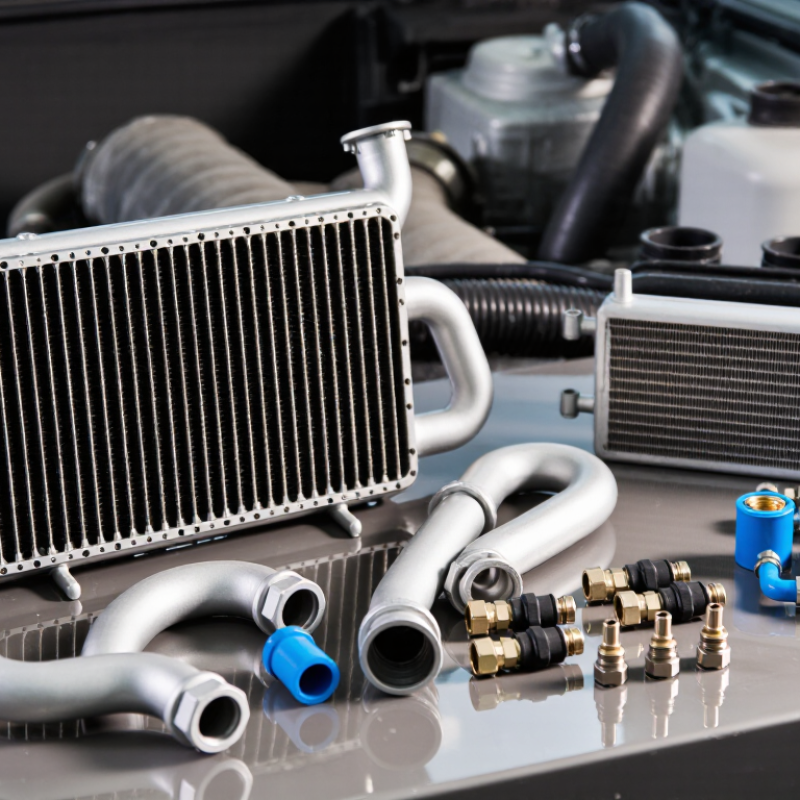
Turbo intercooler designs differ in heat transfer and vehicle fit. Air-to-air cores use outside airflow to cool compressed intake air. They are relatively simple, with no separate coolant circuit. Front-mounted layouts often suit vehicles with clear grille airflow. Top-mounted cores can fit compact engine bays, though they depend on effective hood ducting.

Air-to-water systems pass heat from intake air into a liquid coolant circuit. They can suit tight engine compartments or applications needing short intake routes. The trade-off is added equipment, including a pump, hoses, and a heat exchanger. Packaging matters.

Tips: Check core dimensions, inlet and outlet positions, and available airflow before choosing. Ask for pressure-drop and heat-rejection data at your expected operating conditions. Small details count.

A larger core is not automatically better. Excessive restriction can reduce airflow, while poor duct sealing may let air bypass the fins. In practical installations, inspect hose bends and mounting points; tight bends can complicate fitment. Results vary with vehicle speed, ambient temperature, and engine load. Test under realistic conditions when possible. Even a well-matched design can disappoint if airflow around the core is blocked.

How to Compare Intercooler Performance and Compatibility

2026 Top Turbo Intercooler Types for Global Buyers
How to Compare Intercooler Performance and Compatibility

Air-to-air and air-to-water intercoolers solve the same problem differently. Air-to-air units use passing airflow, so core placement and vehicle speed matter. Air-to-water systems use coolant and can package neatly in tight engine bays, but add a pump, reservoir, and hoses. Compare outlet temperature and pressure drop under the same airflow and boost conditions. SAE International’s J1723 Charge Air Cooler Test Procedure provides a standardized basis for evaluating cooler performance. Ask for test conditions, not just a headline temperature.

Numbers need context. As an illustrative ideal-gas calculation, cooling charge air from 120°C to 60°C at unchanged pressure raises its theoretical density by about 18%. That is not an 18% power guarantee; engine calibration, pressure loss, and ambient heat all matter. Small details count. Check core dimensions, inlet and outlet diameter, mounting points, and pressure rating against the vehicle’s space and operating range. I would also inspect pressure-drop data: a cooler that lowers temperature impressively may still restrict airflow. Bench results can mislead if they do not reflect real ducting or heat soak. Verify fit and performance together.

2026 Top Turbo Intercooler Types for Global Buyers - How to Compare Intercooler Performance and Compatibility

Intercooler Type Core Construction Cooling Performance Airflow Restriction Weight and Packaging Typical Installation Compatibility Checks Main Trade-Offs
Air-to-Air Bar-and-Plate Stacked aluminum plates form separate air passages and cooling fins. Generally strong heat rejection under sustained load when core size and airflow are adequate. Depends on core thickness, fin design, end tanks, and airflow rate; compare pressure-drop data at a stated flow. Typically heavier and more robust than a comparable tube-and-fin core; may need more mounting support. Commonly used in front-mount and other positions with a clear path to ambient air. Check available space, ducting, pipe diameter, inlet and outlet orientation, radiator and condenser clearance, and bumper-beam clearance. Durable construction, but added mass and a dense core can affect packaging and airflow if poorly positioned.
Air-to-Air Tube-and-Fin Air flows through tubes connected by external fins; the design can be built in a range of core sizes. Can provide effective cooling for many road and moderate-performance applications when correctly sized. Varies by tube layout, fin density, core dimensions, and flow; avoid comparing pressure-drop figures taken at different test conditions. Often lighter than a similarly sized bar-and-plate unit; actual weight depends on materials and construction. Used in front-mount, top-mount, or other air-exposed layouts, subject to vehicle packaging. Verify core dimensions, mounting points, pipe routing, exposure to outside airflow, and protection from road debris. Lower mass can aid packaging, while heat capacity and durability depend on the specific core design and operating conditions.
Air-to-Water Compressed intake air transfers heat to a liquid coolant in the charge-air cooler; a pump circulates coolant through a separate heat exchanger. Can provide consistent charge-air cooling in restricted or variable-airflow locations; sustained performance depends on the complete coolant system. Charge-air pressure drop depends on the cooler core and plumbing; coolant-side restriction also affects pump and system requirements. Packaging is distributed across the charge-air cooler, pump, hoses, coolant reservoir, and separate heat exchanger. Useful where a short charge-air path or limited ambient-air access is important; the heat exchanger is placed where it receives suitable airflow. Check pump capacity, coolant volume, heat-exchanger space, electrical supply, hose routing, bleed access, and charge-air connection dimensions. Offers flexible placement, but adds system complexity, components, maintenance needs, and dependence on correct coolant circulation.

Comparison guidance: performance is vehicle- and installation-specific. For a fair technical comparison, use test data recorded at comparable airflow, inlet temperature, ambient temperature, and pressure conditions. Confirm dimensions, connections, mounting points, and required supporting components before purchase.

How Global Buyers Can Choose and Maintain an Intercooler

Choosing an intercooler starts with the engine’s heat load, airflow, and available space—not core size alone. Air-to-air units are simpler and usually easier to service; air-to-water systems can package tightly but add a pump, coolant, and more failure points. Measure the inlet and outlet temperatures under repeatable load. A 20°C drop, from 60°C to 40°C, would raise air density by about 6% at equal pressure, using the ideal gas relationship. Real results vary. Small details matter.

The U.S. EPA’s 2024 Automotive Trends Report puts model-year 2023 average fuel economy at 27.1 mpg. That fleet figure is not an intercooler performance claim; it is a reminder that vehicle efficiency depends on the whole system. For fair power comparisons, use consistent conditions and a recognized procedure such as SAE J1349. Check pressure drop as well as cooling: a cooler that restricts flow may undermine the gain. I would not choose from catalogue dimensions alone.

Maintenance is practical, not glamorous. Inspect fins for bent sections, road debris, and oily residue; clean gently without flattening the core. Check hoses and clamps after heat cycles, and look for coolant loss in liquid-cooled setups. Record boost pressure and charge temperatures before and after service. If readings drift, verify the sensor and test conditions before blaming the intercooler. Some installations still need a second fitment check. That is worth admitting.

Blogs