2026 Best Molded Case Breaker Types for Global Buyers
Choosing the right molded case breaker in 2026 requires more than comparing ampere ratings. Global buyers must examine breaking capacity, trip technology, thermal limits, installation conditions, and after-sales support. A compact breaker may fit a crowded panel, yet fail under high fault current. That detail matters.
Recent market studies from Grand View Research and MarketsandMarkets continue to identify industrial expansion, data centers, renewable-energy projects, and commercial construction as major circuit-breaker demand drivers. Their findings also point toward smarter protection, digital monitoring, and higher energy-efficiency expectations. However, market forecasts vary by research method. Buyers should test every headline against technical specifications and project evidence.
IEC 60947-2 remains a central reference for low-voltage circuit-breakers, including molded case breaker performance and verification. UL 489 also remains important for many North American applications. These standards do not make every product equally suitable. Short-circuit ratings, selectivity tables, coordination studies, and ambient-temperature derating still require engineering judgment.
As electrical engineer and author Paul Gill notes, “Protection is only effective when it is properly applied.” That principle is easy to overlook. A breaker with advanced electronics cannot correct poor cable sizing, weak maintenance, or an inaccurate fault study.
This guide compares the best molded case breaker types for global buyers. It considers thermal-magnetic, electronic-trip, adjustable, current-limiting, and communication-enabled designs. The practical question is simple: will the breaker protect the equipment, the people, and the operation when conditions become severe?
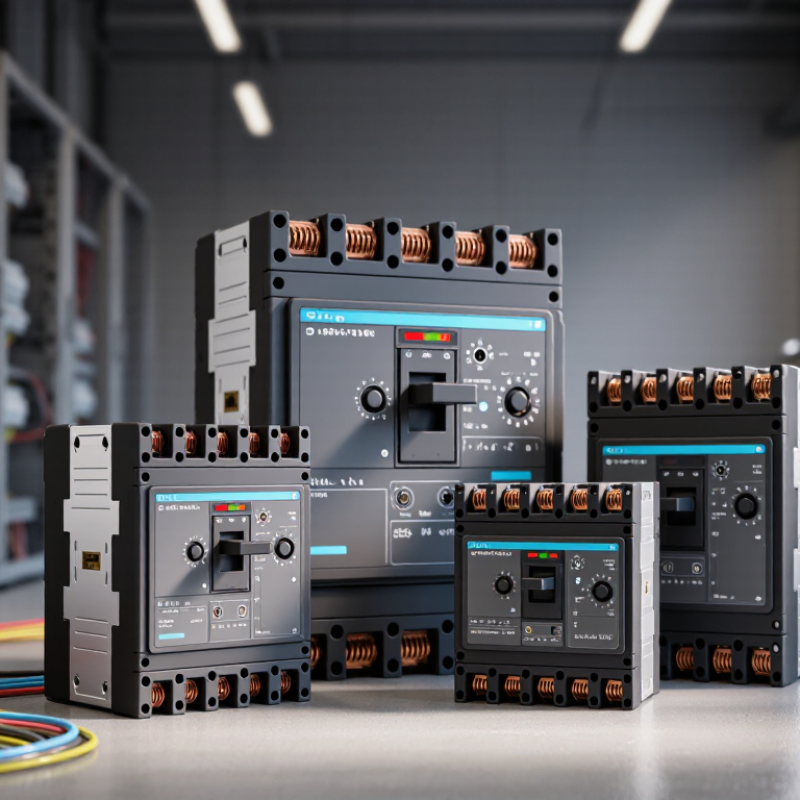
Molded Case Circuit Breaker Fundamentals for Global Buyers
Molded Case Circuit Breaker Fundamentals for Global Buyers
A molded case circuit breaker protects low-voltage circuits from overloads and short circuits. Its insulated housing supports safe operation inside distribution panels. The basic parts include contacts, an arc-control system, and a trip unit. Thermal-magnetic models respond to heat and sudden fault current. Electronic trip units provide more adjustable protection. That flexibility helps with motors, transformers, and sensitive equipment.
Global buyers should check rated current, service voltage, frequency, pole configuration, and short-circuit interrupting capacity. These values must match the installation, not only the equipment label. A breaker rated for 250 A may still be unsuitable for a panel with limited fault capacity. Ambient temperature matters too. At 40°C, continuous loading can differ from laboratory expectations. Cable size, terminal space, enclosure conditions, and coordination with upstream devices also deserve careful review. Field experience often reveals overlooked details. Selection is not always perfect.
Tips: Request test reports, wiring diagrams, dimensional drawings, and trip curves before purchase. Confirm the applicable regional standard and certification route with a qualified engineer. Ask whether accessories, terminals, and maintenance instructions suit your local panel design. Keep spare settings documented. Small errors become expensive during commissioning.
Main MCCB Types and Their Operating Principles
Molded case circuit breakers differ mainly by trip technology, adjustment range, and interruption behavior. For global buyers, the right MCCB depends on load current, fault level, ambient temperature, and installation conditions. A breaker that works well in a cool factory may nuisance-trip inside a hot, crowded cabinet.
Thermal-magnetic MCCBs use two mechanisms. A bimetal strip bends slowly during overload and opens the circuit after heating. A magnetic solenoid reacts almost instantly to high fault current. This combination suits motors, feeders, and general distribution. Thermal settings may drift with temperature. That detail is easy to overlook. Some projects need temperature derating data before selection.
Electronic-trip MCCBs measure current through sensors and process the signal electronically. They can provide adjustable long-time, short-time, instantaneous, and ground-fault protection. This supports coordination across several distribution levels. Current-limiting MCCBs use shaped contacts and arc-control chambers to reduce let-through energy during short circuits. Their performance depends on verified test ratings.
During panel inspections, I check conductor size, terminal heating, and available fault current, not only the label rating. A higher ampere rating is not automatically safer. Designers should confirm pole configuration, insulation voltage, trip curves, maintenance access, and applicable certification requirements. I have seen errors caused by copying an old schedule. Rechecking the real load is slower, but usually cheaper than correcting unsuitable protection.
Key MCCB Ratings, Features, and Protection Functions
For global buyers, MCCB ratings should match the actual installation, not only the expected load. Check rated current, frame size, operating voltage, frequency, and number of poles. A 250 A frame may protect a smaller circuit, but its trip setting must suit the conductor. Interrupting capacity is equally important. Icu shows the ultimate short-circuit breaking capacity, while Ics indicates service breaking performance. These values should exceed the prospective fault current at the installation point.
Protection functions depend on the application. Thermal-magnetic MCCBs offer reliable overload and short-circuit protection for common distribution panels. Electronic trip units can provide adjustable long-time, short-time, instantaneous, and earth-fault settings. Selectivity between upstream and downstream breakers can reduce unnecessary shutdowns. Useful features may include shunt trips, undervoltage releases, auxiliary contacts, rotary handles, and visible isolation positions. In practice, the first selection is often wrong when cable length and temperature are ignored.
Tips:
Confirm local electrical requirements, installation altitude, ambient temperature, and enclosure conditions before ordering. Request tested performance data and a clear trip curve. Do not compare price alone. A lower-cost breaker may lack the adjustment range needed for coordination. Also, verify terminal size and installation space; a technically suitable MCCB can still become difficult to wire. These small details deserve review before final approval.
Global Standards and Regional Selection Requirements
2026 Best Molded Case Breaker Types for Global Buyers
Global Standards and Regional Selection Requirements
Molded case circuit breakers are not selected by amperage alone. The IEA’s Electricity 2024 report expects global electricity demand to grow by about 4% annually through 2026. That growth increases pressure on low-voltage distribution systems, especially in factories, data centers, and commercial buildings. Thermal-magnetic MCCBs suit stable loads and simpler installations. Electronic-trip types offer adjustable protection, event monitoring, and better coordination for variable or critical loads. The choice should reflect the actual fault level, not only the normal operating current.
Regional compliance changes the buying decision. IEC 60947-2 is widely used across Europe, Asia, Africa, and many Middle Eastern projects. North American installations commonly require UL 489 and CSA C22.2 No. 5 evaluation. Australia and New Zealand may reference AS/NZS 60947.2, while India often applies IS/IEC 60947-2. Buyers should verify Icu, Ics, voltage, pole configuration, frequency, and temperature derating under the target system standard. Local certification and authority approval can still affect acceptance.
A neat global checklist is tempting, but it can mislead. Short-circuit ratings may change with installation conditions, altitude, enclosure design, and upstream coordination. I would request verified test documentation, not just a catalog value. Electronic protection is powerful, yet unnecessary complexity can increase commissioning errors. Sometimes, the simpler breaker is safer. Selection teams should compare field experience, maintenance skills, spare availability, and regional service capability before finalizing the type.
How to Choose the Best MCCB for Different Applications
2026 Best Molded Case Breaker Types for Global Buyers
Choosing the best MCCB starts with the application, not the product price. Thermal-magnetic MCCBs suit general distribution, small commercial panels, and steady loads. They provide dependable overload and short-circuit protection with simple adjustment. For motors, pumps, and compressors, check starting current carefully. An unsuitable trip setting may cause nuisance shutdowns.
Electronic-trip MCCBs offer adjustable long-time, short-time, instantaneous, and ground-fault protection. They fit factories, hospitals, data rooms, and systems requiring selective coordination. Current-limiting types can reduce fault energy and protect downstream equipment. Solar installations need special attention to direct-current ratings, polarity, and isolation requirements. Do not assume an AC breaker is suitable for DC circuits.
Breaking capacity must exceed the prospective short-circuit current at the installation point. Confirm voltage, frequency, number of poles, frame size, and trip-unit range. IEC 60947-2 provides a useful technical reference, but local rules still control the final selection. Enclosure temperature also matters. A breaker inside a hot, crowded panel may carry less current than its nameplate suggests.
Details matter. Field checks should include conductor size, terminal torque, ambient temperature, and coordination with upstream devices. A common mistake is selecting a higher-rated frame without confirming cable protection. Bigger is not always safer. Manufacturers’ test data should be reviewed, although real installations can still reveal unexpected heat or vibration. Leave room for testing and future load changes.
2026 Best Molded Case Breaker Types for Global Buyers
How to Choose the Best MCCB for Different Applications
The chart shows representative continuous-current selection bands commonly used for low-voltage MCCB applications. Smaller molded case breakers are typically used for final distribution, while higher-current adjustable electronic MCCBs are more suitable for industrial feeders and main incomers. Final selection should also verify system voltage, available short-circuit current, breaking capacity, load type, ambient temperature, coordination, and local electrical requirements. MCCBs are covered by IEC 60947-2, but exact ratings and application limits vary by product design.